Showing posts with label France UNESCO. Show all posts

Wednesday, April 9, 2025

France: The Maison Carrée of Nîmes

Built in the 1st century AD in the Roman colony of Nemausus – today’s city of Nîmes in the Occitanie region– the Maison Carrée is one of the earliest examples of a Roman temple which can be connected to the imperial worship in the provinces of Rome. Dedicated to the presumptive heirs of Augustus, the princes of Youth, prematurely deceased, this building confirmed the control of Rome on the conquered territory while expressing in a symbolic way the allegiance and attachment of the people from the city of Nemausus to Augustus’ dynasty. The architecture of the Maison Carrée and its sophisticated decoration took part, symbolically, in the dissemination of Augustus ideologic program which turned the Ancient Rome from republic to empire, thus opening a new golden age bearer of promises of peace, prosperity and stability known by the name of Pax Romana. source:whs.unesco.org
Inscribed: 2023


 Thanks to Ms Nadia

Tuesday, February 25, 2025

The Great Spa Towns of Europe


Austria-Belgium- Czechia- France-Germany-Italy- UK
This transnational property comprises 11 towns, located in seven European countries: Baden bei Wien (Austria); Spa (Belgium); Františkovy Lázně (Czechia); Karlovy Vary (Czechia); Mariánské Lázně (Czechia); Vichy (France); Bad Ems (Germany); Baden-Baden (Germany); Bad Kissingen (Germany); Montecatini Terme (Italy); and City of Bath (United Kingdom). All of these towns developed around natural mineral water springs. They bear witness to the international European spa culture that developed from the early 18th century to the 1930s, leading to the emergence of grand international resorts that impacted urban typology around ensembles of spa buildings such as the kurhaus and kursaal (buildings and rooms dedicated to therapy), pump rooms, drinking halls, colonnades and galleries designed to harness the natural mineral water resources and to allow their practical use for bathing and drinking. Related facilities include gardens, assembly rooms, casinos, theatres, hotels and villas, as well as spa-specific support infrastructure. These ensembles are all integrated into an overall urban context that includes a carefully managed recreational and therapeutic environment in a picturesque landscape. Together, these sites embody the significant interchange of human values and developments in medicine, science and balneology. source:whc.unesco.org

1. Austria- Baden Bei Wein- Received
2. Belgium- Spa
3. Czech Republic-Frantiskovy Lazne
4. Czech Republic- Karlovy Vary
5. Czech Republic- Marianske Lazne
6. France- Vichy- Received
7. Germany- Bad ems
8. Germany- Baden Baden
9. Germany- Bad Kissigen- Received
10. Italy- Montecatini Terme- Received
11. United Kingdom- Bath- Received
Inscribed: 2021

France- Vichy


Thanks to Ms Julie.

Austria- Baden Bei Wein


Thanks to MS Monika. 

United Kingdom -The City of Bath


Thanks to Ms Nat.
 Germany- Bad Kissingen


Thanks to Ms Svenja
Italy- Montecatini Terme

Thanks to Ms Martha Isabel

Wednesday, September 11, 2024

Belgium: Belfries of Belgium and France

Twenty-three belfries in the north of France and the belfry of Gembloux in Belgium were inscribed as a group, an extension to the 32 Belgian belfries inscribed in 1999 as Belfries of Flanders and Wallonia. Built between the 11th and 17th centuries, they showcase the Roman, Gothic, Renaissance and Baroque styles of architecture. They are highly significant tokens of the winning of civil liberties. While Italian, German and English towns mainly opted to build town halls, in part of north-western Europe, greater emphasis was placed on building belfries. Compared with the keep (symbol of the seigneurs) and the bell-tower (symbol of the Church), the belfry, the third tower in the urban landscape, symbolizes the power of the aldermen. Over the centuries, they came to represent the influence and wealth of the towns. Source: whc.unesco.org
Inscribed: 1999 Ext:2005
List of Belfries: 
BELGIUM
A) FLANDERS
Antwerp
- Antwerp Cathedral of Our Lady-Received
- Antwerp City Hall
- Herentals Former City & 'Laken'(Cloth) Hall
- Lier City Hall and Belfry tower
- Mechelen St. Rumbolds Tower of the cathedral- Received
- Mechelen Old Cloth Hall with Belfry, oldest part of the present-day City Hall
West Flanders
- Bruges Belfry known as Halletoren (Tower of the Halls) and [Market] Halls- Received
- Diksmuide City Hall and Belfry
- Kortrijk Belfry known as Halletoren (Tower of the Hall) 
- Lo-Reninge (Lo) Former City Hall with Belfry, at present a hotel
- Menen City Hall and adjacent Belfry
- Nieuwpoort Grain Hall known as Stadshalle (City's [Market] Hall), with Belfry
- Roeselare City Hall, City's Market Hall, and Belfry
- Tielt Belfry known as Hallentoren (Tower of the Halls), Cloth Hall and Aldermen's Chamber
- Veurne Landhuis ("country-house", former seat of the Viscounty of Veurne-Ambacht) and Belfry
- Ypres Cloth Hall with Belfry
East Flanders
- Aalst Aldermen's House with Belfry
- Dendermonde City Hall with Belfry
- Eeklo City Hall with Belfry
- Ghent Belfry, Cloth Hall and Mammelokker- Received
- Oudenaarde City Hall with Belfry
Flemish Brabant
- Leuven St. Peter's Church and tower- Received
- Tienen St. Germanus Church with Stadstoren (City Tower)
- Zoutleeuw St. Leonard's Church
Limburg
- Sint-Truiden City Hall with Tower
- Tongeren Basilica of Our Lady with Stadstoren (City Tower)
B) WALLONIA
Hainaut
- Binche Belfry of the City Hall
- Charleroi Belfry of the City Hall
- Mons Belfry
- Thuin Belfry
- Tournai Belfry
Namur
- Gembloux Belfry
- Namur Belfry

 FRANCE
A) NORD-PAS DE CALAIS
Nord
- Armentières Belfry of the City Hall
- Bailleul Belfry of the City Hall
- Bergues Belfry
- Cambrai Belfry of the St. Martin's Church
- Comines Belfry of the City Hall
- Douai Belfry of the City Hall
- Dunkirk Belfry of the City Hall
- Dunkirk Belfry of the St. Eligius Church
- Gravelines Belfry
- Lille Belfry of the City Hall-Received
- Loos Belfry of the City Hall
Pas-de-Calais
- Aire-sur-la-Lys Belfry of the City Hall
- Arras Belfry of the City Hall
- Béthune Belfry
- Boulogne-sur-Mer Belfry of the City Hall
- Calais Belfry of the City Hall
- Hesdin Belfry of the City Hall
B) PICARDY
Somme
- Abbeville Belfry
- Amiens Belfry-Received
- Doullens Belfry of the former Municipal Hall, at present the tourist information center
- Lucheux Belfry on the remaining City Gate
- Rue Belfry
- Saint-Riquier Belfry

Postcard 1: Gent 


Thanks to Ms Tani

Postcard 2: Brugges Belfry (Belgium)


Thanks to Ms Lotty

Postcard 3: Belfries in Belgium (Multi-View)


Thanks to Dager.

Postcard 4: St. Peter's Church and Tower,  Leuven (Belgium)


Thanks to 'Miss Patitav'

Postcard 5: St. Rumbolds Tower of the Cathedral, Mechelen (Belgium)


Thanks to Mr Javier.

Postcard 6: Cathedral of Our Lady, Antwerp


Thanks to Ms Tania.


Postcard 7: Lille Belfry ( France)


Thanks to Mr Vincent

Tuesday, July 5, 2022

France: Cordouan Lighthouse

The Lighthouse of Cordouan rises up on a shallow rocky plateau in the Atlantic Ocean at the mouth of the Gironde estuary in the Nouvelle-Aquitaine region, in a highly exposed and hostile environment. Built in white limestone dressed blocks at the turn of the 16th and 17th centuries, it was designed by engineer Louis de Foix and remodelled by engineer Joseph Teulère in the late 18th century. A masterpiece of maritime signalling, Cordouan’s monumental tower is decorated with pilasters, columns modillions and gargoyles. It embodies the great stages of the architectural and technological history of lighthouses and was built with the ambition of continuing the tradition of famous beacons of antiquity, illustrating the art of building lighthouses in a period of renewed navigation, when beacons played an important role as territorial markers and as instruments of safety. Finally, the increase of its height, in the late 18th century, and the changes to its light chamber, attest to the progress of science and technology of the period. Its architectural forms drew inspiration from ancient models, Renaissance Mannerism and the specific architectural language of France’s engineering school École des Ponts et Chaussées. Source:whc.unesco.org
Inscribed: 2021


Thanks to Maud

Thursday, May 26, 2022

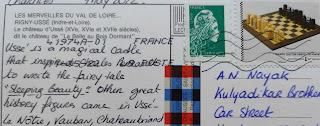
France: The Loire Valley between Sully-sur-Loire and Chalonnes

The Loire Valley is an outstanding cultural landscape of great beauty, containing historic towns and villages, great architectural monuments (the châteaux), and cultivated lands formed by many centuries of interaction between their population and the physical environment, primarily the river Loire itself. source:whc.unesco.org
Inscribed: 2000 Extn: 2017

Postcard 1: Chateau d'Usse

Thanks to Mr Maud
Postcard 2: Chambord

Thanks to Ms Ulla.
Postcard 3: Saumur

Monday, October 18, 2021

France: Chaîne des Puys - Limagne fault tectonic arena

Situated in the centre of France, the property comprises the long Limagne fault, the alignments of the Chaîne des Puys volcanoes and the inverted relief of the Montagne de la Serre. It is an emblematic segment of the West European Rift, created in the aftermath of the formation of the Alps, 35 million years ago. The geological features of the property demonstrate how the continental crust cracks, then collapses, allowing deep magma to rise and cause uplifting at the surface. The property is an exceptional illustration of continental break-up – or rifting – which is one of the five major stages of plate tectonics. Source:whc.unesco.org
Inscribed: 2018


Thanks to Ms Maud.

Saturday, August 14, 2021

France: Nice, Winter Resort Town of the Riviera

The Mediterranean city Nice, near the Italian border, bears witness to the evolution of the winter climatic resort due to the city’s mild climate and seaside location at the foot of the Alps. From the middle of the 18th century, Nice attracted an increasing number of aristocratic and upper-class families, mainly British, who took to spending their winters there. In 1832, Nice, then part of the Kingdom of Savoy-Piedmont-Sardinia, adopted a regulatory urban plan aiming to make it attractive to foreigners. Shortly thereafter, the Camin dei Inglesi, a modest 2-metre wide path along the sea shore, was expanded to become a prestigious promenade, known as the Promenade des Anglais after the city was ceded to France in 1860. Over the next century, an increasing number of winter residents from other countries, notably Russia, flocked to the city driving successive phases of development of new areas next to the old medieval town. The diverse cultural influences of the winter residents and the desire to make the most of the climatic conditions and scenery of the place, shaped the urban planning and eclectic architectural styles of those areas, contributing to the city’s renown as a cosmopolitan winter resort. Source:whc.unesco.org
Inscribed: 2021


Friday, March 15, 2019

The Architectural Work of Le Corbusier, an Outstanding Contribution to the Modern Movement

Argentina-Belgium-France-Germany-India-Japan-Switzerland
Chosen from the work of Le Corbusier, the 17 sites comprising this transnational serial property are spread over seven countries and are a testimonial to the invention of a new architectural language that made a break with the past. They were built over a period of a half-century, in the course of what Le Corbusier described as “patient research”. The Complexe du Capitole in Chandigarh (India), the National Museum of Western Art, Tokyo (Japan), the House of Dr Curutchet in La Plata (Argentina) and the Unité d’habitation in Marseille (France) reflect the solutions that the Modern Movement sought to apply during the 20th century to the challenges of inventing new architectural techniques to respond to the needs of society. These masterpieces of creative genius also attest to the internationalization of architectural practice across the planet. Source:whc.unesco.org
Inscribed: 2016

INDIA:
1) Complexe du Capitole-Received
JAPAN:
2) Musée National des Beau-Arts de l’Occident -Received
BELGIUM:
3) Maison Guiete- Received
GERMANY:
4) Maisons de la Weissenhof-Siedlung-Received
FRANCE:
5) Chapelle Notre-Dame-du-Haut de Ronchamp
6) Unité d’habitation Marseille
7) Maisons La Roche et Jeanneret 
8) Cité Frugès 
9) Villa Savoye et loge du jardiner 
10) Immeuble locatif à la Porte Molitor 
11) La Manufacture à Saint- Dié 
12) Cabanon de Le Corbusier 
13) Couvent Sainte-Marie-de-la-Tourette 
14) Maison de la Culture de Firminy 
SWITZERLAND:
15) Petite villa au bord du lac Léman- Received
16) Immeuble Clarté 
ARGENTINA:
17) Maison du docteur Curutchet

India: Complexe du Capitole


Thanks to Mr Sanket.

Japan: Musée National des Beaux-Arts de l’Occident


Thanks to Ms Bie Hao. 

Japan: Musée National des Beaux-Arts de l’Occident


Thanks to Ms Seeta.
Belgium: Maison Guiete


Thanks to Mr Zavier who was visiting Belgium.

Germany: Maisons de la Weissenhof-Siedlung


Thanks to Ms Steffi.

Germany: Maisons de la Weissenhof-Siedlung (Outer View, Bottom Left)


France: Showing all the Sites around the world including France


Thanks to Mr Zavier of Spain.This postcard issued by Le Corbusier foundation.

Switzerland: Petite villa au bord du lac Léman

Thanks to Mr Oscar.

Saturday, September 15, 2018

France: Pont du Gard (Roman Aqueduct)

The Pont du Gard was built shortly before the Christian era to allow the aqueduct of Nîmes (which is almost 50 km long) to cross the Gard river. The Roman architects and hydraulic engineers who designed this bridge, which stands almost 50 m high and is on three levels – the longest measuring 275 m – created a technical as well as an artistic masterpiece. Source: whc.unesco.org
Inscribed: 1985 Ext:2007

Postcard 1

Thanks to Ms Ulla.
Postcard 2

Thanks to Ms Lucei.