Showing posts with label Croatia UNESCO. Show all posts

Tuesday, August 25, 2026

Croatia:Episcopal Complex of the Euphrasian Basilica in the Historic Centre of Poreč

The group of religious monuments in Porec, where Christianity was established as early as the 4th century, constitutes the most complete surviving complex of its type. The basilica, atrium, baptistery and episcopal palace are outstanding examples of religious architecture, while the basilica itself combines classical and Byzantine elements in an exceptional manner. Source:whc.unesco.org
Inscribed: 1997


Thanks to Ms Nikola. 

Tuesday, February 25, 2025

Stećci Medieval Tombstone Graveyards

Bosnia & Herzegovina-Croatia- Montenegro- Serbia
This serial property combines 28 sites, located in Bosnia and Herzegovina, western Serbia, western Montenegro and central and southern Croatia, representing these cemeteries and regionally distinctive medieval tombstones, or stećci. The cemeteries, which date from the 12th to 16th centuries CE, are laid out in rows, as was the common custom in Europe from the Middle Ages. The stećci are mostly carved from limestone. They feature a wide range of decorative motifs and inscriptions that represent iconographic continuities within medieval Europe as well as locally distinctive traditions. source:whc.unesco.org
Inscribed: 2016

Postcard 1: Croatia


 Thanks to Ms Nikola.
Postcard 2: Montenegro


Thanks to Ms Marcel of Germany.

Wednesday, July 10, 2024

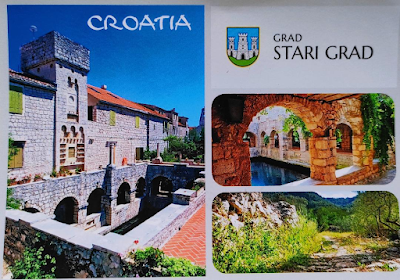
Croatia: Stari Grad Plain

Stari Grad Plain on the Adriatic island of Hvar is a cultural landscape that has remained practically intact since it was first colonized by Ionian Greeks from Paros in the 4th century BC. The original agricultural activity of this fertile plain, mainly centring on grapes and olives, has been maintained since Greek times to the present. The site is also a natural reserve. The landscape features ancient stone walls and trims, or small stone shelters, and bears testimony to the ancient geometrical system of land division used by the ancient Greeks, the chora which has remained virtually intact over 24 centuries.
Source:whc.unesco.org
Inscribed : 2008


Thanks to Ms Nikola of Croatia.


Thursday, November 14, 2019

Venetian Works of Defence between the 16th and 17th Centuries: Stato da Terra – Western Stato da Mar

Croatia-Italy-Montenegro
This property consists of 6 components of defence works in Italy, Croatia and Montenegro, spanning more than 1,000 km between the Lombard region of Italy and the eastern Adriatic Coast. The fortifications throughout the Stato da Terra protected the Republic of Venice from other European powers to the northwest and those of the Stato da Mar protected the sea routes and ports in the Adriatic Sea to the Levant. They were necessary to support the expansion and authority of the Serenissima. The introduction of gunpowder led to significant shifts in military techniques and architecture that are reflected in the design of so-called alla moderna / bastioned, fortifications, which were to spread throughout Europe. source:whc.unesco.org
Inscribed: 2017

Croatia: Zadir

Thanks to Antich of Croatia.
Italy: Bergamo

Thanks to Mr Boris.
Montenegro: Kotor

Thanks to Heidi.

Friday, August 9, 2019

Croatia: Plitvice Lakes National Park

The waters flowing over the limestone and chalk have, over thousands of years, deposited travertine barriers, creating natural dams which in turn have created a series of beautiful lakes, caves and waterfalls. These geological processes continue today. The forests in the park are home to bears, wolves and many rare bird species. Source:whc.unesco.org
Inscribed: 1979 Extn: 2000

Postcard 1

Thanks to Dr Kiran Acharya.
Postcard 2

Thanks to Ms Blanka.

Tuesday, June 12, 2018

Ancient and Primeval Beech Forests of the Carpathians and Other Regions of Europe

Albania/ Austria/ Belgium/ Bulgaria/ Croatia/ Germany/ Italy/ Romania/ Slovakia/ Slovenia/ Spain/ Ukraine:
Missing: Albania, Bulgaria, Italy, Romania, Slovenia
This transboundary extension of the World Heritage site of the Primeval Beech Forests of the Carpathians and the Ancient Beech Forests of Germany (Germany, Slovakia, Ukraine) now stretches over 12 countries. Since the end of the last Ice Age, European beech spread from a few isolated refuges in the Alps, Carpathians, Mediterranean and Pyrenees over a short period of a few thousand years in a process that is still ongoing. This successful expansion is related to the tree’s flexibility and tolerance of different climatic, geographical and physical conditions. Source: whs.unesco.org
Inscribed: 2007 Ext-2011, 2017

Austria: Kalkalpen National Park


Thanks to Ms Nastya of Russia.
Croatia: Hajdučki i Rožanski kukovi


Thanks to Ms Nikol

Belgium: Soignes Forest


Thanks to Mr Javier.
Germany: Jasmund National Park


Slovakia: Poloniny National Park


Postcard from Radio Slovakia.
Spain: Picos de Europa National Park


Thanks to Mr Javier

Ukraine: East Carpathian Biosphere Reserve


Thanks to Mr Sergei.

Tuesday, July 1, 2014

Croatia: The Cathedral of St James in Sibenik

The Cathedral of St James in Šibenik (1431-1535), on the Dalmatian coast, bears witness to the considerable exchanges in the field of monumental arts between Northern Italy, Dalmatia and Tuscany in the 15th and 16th centuries. The three architects who succeeded one another in the construction of the Cathedral - Francesco di Giacomo, Georgius Mathei Dalmaticus and Niccolò di Giovanni Fiorentino - developed a structure built entirely from stone and using unique construction techniques for the vaulting and the dome of the Cathedral. The form and the decorative elements of the Cathedral, such as a remarkable frieze decorated with 71 sculptured faces of men, women, and children, also illustrate the successful fusion of Gothic and Renaissance art. Source:whc.unesco.org
Inscribed: 2000


Thanks to Ms Agatha Juran.

Croatia: Historic City of Trogir

Trogir is a remarkable example of urban continuity. The orthogonal street plan of this island settlement dates back to the Hellenistic period and it was embellished by successive rulers with many fine public and domestic buildings and fortifications. Its beautiful Romanesque churches are complemented by the outstanding Renaissance and Baroque buildings from the Venetian period. Source:whc.unesco.org
Inscribed: 1997

Postcard 1: Kamerlengo Castle


Postcard 2: Harbour Town

Thanks to Ms Agi for both the cards.